Table Of Content

An additional consideration is that hair testing may “over-detect” recent use insofar as it is unfeasible to precisely measure and cut one month’s worth of hair growth, so hair tests may detect use that occurred beyond the past month. We believe this limitation may be a strength when utilizing hair tests to detect use within a more extensive time period, such as past year or past 3-month use. However, for this reason, it is also unknown if recent drug use (e.g., cocaine use) was underreported or over-detected. For example, unknown exposure to adulterant drugs is common among users of illegal drugs.
Complete Guide to STD Testing
Similarly, our findings suggest that urine testing is more efficacious than hair testing in detecting benzodiazepines, validating just over half of self-reported use. To our knowledge, only one other validity study within the past several decades has included benzodiazepines in their analyses (Li et al., 2019). Though their findings were limited to sexual minorities, Li et al. also reported a fair level of agreement between urine test results and self-report of benzodiazepine use.
Negative
A person can usually access their test results by calling a toll-free number or going online and using the unique identification number that comes with the kit. By Jaime R. Herndon, MS, MPHHerndon is a freelance health/medical writer with a graduate certificate in science writing from Johns Hopkins University. You can always ask to retest if you think your test results are inaccurate. We’re passionate about giving you the most accurate, up-to-date information available. All our content is created and reviewed by experts in the field, ensuring the highest level of Expertise, Authoritativeness, and Trustworthiness (E-A-T). The Sprout Health Group editorial team is passionate about addiction treatment, recovery and mental health issues.
How to test employees for cannabis impairment - Canadian Occupational Safety
How to test employees for cannabis impairment.
Posted: Thu, 13 Dec 2018 08:00:00 GMT [source]
Questions for your doctor about test results
In this case, your employer will likely request you provide documentation of prescriptions. If you have very little or no hair on your head, the collector might use body hair for the test instead. The collector will place the hair in foil and then in a secure envelope to be mailed for overnight testing. However, the test may not be able to detect if someone uses drugs very infrequently or uses drugs shortly before the test. There is only one standard for this test, which is 1.5 inches of hair, cut from the root.
The drugs you use can enter and stay in your hair follicles for 90 days or until the hair is removed. The collector obtains a 100-milligram sample of hair (90 to 120 strands) cut at the scalp. The collector secures the hair sample in foil and completes chain of custody documentation in preparation for shipment to the testing laboratory. If a drug test result is positive, a health care provider may ask questions to evaluate the patient for a substance use disorder or addiction.

Hair samples undergo a two-step process to ensure accurate test results. During the test, the tester will remove a small hair sample close to a person’s scalp and send it to a laboratory for overnight testing. Some companies require potential employees to take a drug test as part of their application process, particularly for jobs that carry a high risk of injury.
Drugs Detected
While hair testing is efficacious in detecting drug use in wide window periods (e.g., past-year use), it appears to be less efficacious than urine testing when testing for past-month use of select drugs in opiate/opioid-using samples. However, hair testing does appear to be particularly efficacious in detecting unreported recent use of cocaine and/or oxycodone, and it often adds to the detection power of urine. We believe including urine and/or hair testing as an adjunct to surveys can help “correct” prevalence estimates that are influenced by unreported use.
All nonnegative tests undergo a second test, called gas chromatography/mass spectrometry (GC/MS). While a urine drug screen can detect if you’ve used drugs in the last few days, a hair drug test can detect drug use in the past 90 days. Although hair samples undergo a two-step testing process, they are not 100 percent accurate. If the hair sample is contaminated or something goes wrong during testing, the laboratory may declare the result to be inconclusive. In these cases, a person may need to provide a new hair sample to the laboratory. In a laboratory, a procedure called enzyme-linked immunosorbent assay (ELISA) is performed on the hair sample.
Weed can stay in your system for a few days to a few months - here's how to get it out faster - Yahoo Finance UK
Weed can stay in your system for a few days to a few months - here's how to get it out faster.
Posted: Thu, 25 Mar 2021 07:00:00 GMT [source]
Are follow-up tests necessary?
Prospective participants were asked to provide a urine specimen in the integrated collection cup, and results were read by trained research staff approximately five minutes after collection. According to the Society for Human Resource Management, hair drug tests are used by approximately 7% of employers that screen employees for drug use. This type of drug test may be used by employers, courts, addiction treatment centers, and individuals who want themselves or a loved one tested for drug use, reports the NIH. After a hair sample is collected, it is packaged according to instructions contained in the collection kit and sent to a laboratory for testing. In some cases, the collection of a hair sample will be performed by a trained professional to prevent tampering, contamination, or substitution of the sample.
Contrary to popular belief, there is no way to cleanse your hair of any drug substance. Drugs enter your bloodstream and thus, become embedded in your hair, and it stays there until that hair is removed from your body. To learn more, watch our webinar as we comb through the science of hair testing or connect with us online. If a drug test comes out positive, your doctor will ask you about your drug history. They will evaluate if you are an occasional drug user or need therapy for a more serious condition, drug abuse disorder.
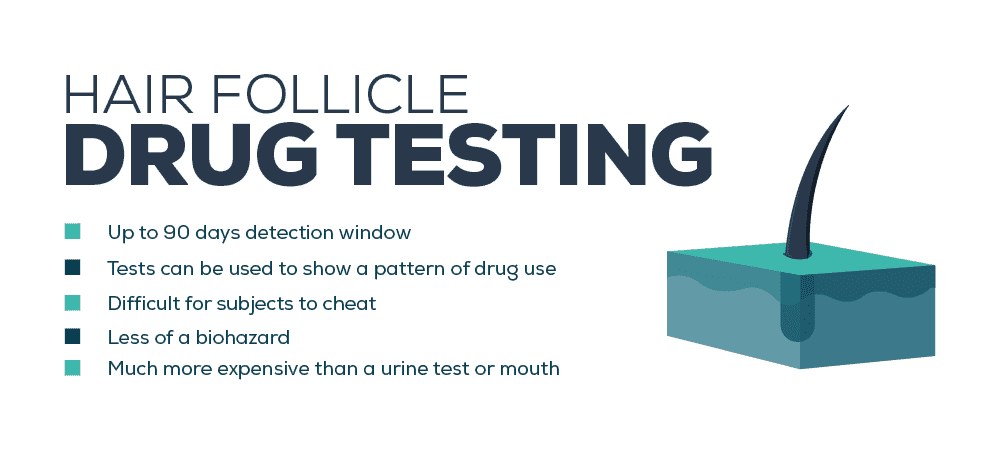
Hair follicle drug tests are used by employers who have zero tolerance drug use policies, courts and individuals on probation. The primary benefit of a hair follicle drug test include a much longer detection period for drug use which typically is up to 90 days. However, when screening drug use within the last 5 days the urine test continues to be the most accurate test.
Participants were urine-tested and the majority (79.9%) provided a hair sample for analysis. We examined the utility of urine vs. hair-testing in detecting past-month use of various drugs. Hair takes time to grow, and hair drug tests may not show whether a person has used drugs during the past few days. Many times, it can take between five and seven days for substances to be detectable on a hair follicle drug test. During hair follicle drug testing, scissors are used to remove a small sample of hair. Compared to other forms of drug testing, hair follicle drug testing offers advantages such as a long detection window and the ability to estimate patterns of drug use over time.
Positive test results indicate that a drug or its metabolite was detected in the sample of hair submitted for testing. Hair follicle drug tests are performed on a sample of hair, usually collected from a person’s scalp. The cost of hair follicle drug testing depends on where a sample is collected, the type of hair follicle drug test ordered, and who is paying for testing. Patient costs may be covered by an individual’s health insurance or the organization requiring a drug test.
Following is the comprehensive table describing specific drugs and substances that a hair follicle drug test is typically designed to detect. There was considerable variability in sensitivity and specificity across drugs, and depending on whether the hair test or self-report was considered the criterion standard. If self-report is considered the criterion standard, hair testing yielded poor sensitivity, ranging from a high of 65.2% (cocaine) to a low of 2.9% (opiates). Specificity of hair testing against self-report exceed 90% for all drugs. Substance abuse treatment in the United States and many other countries is often delivered in a specialty sector, with programs serving patients whose problems have reached a critical threshold of severity.


No comments:
Post a Comment